
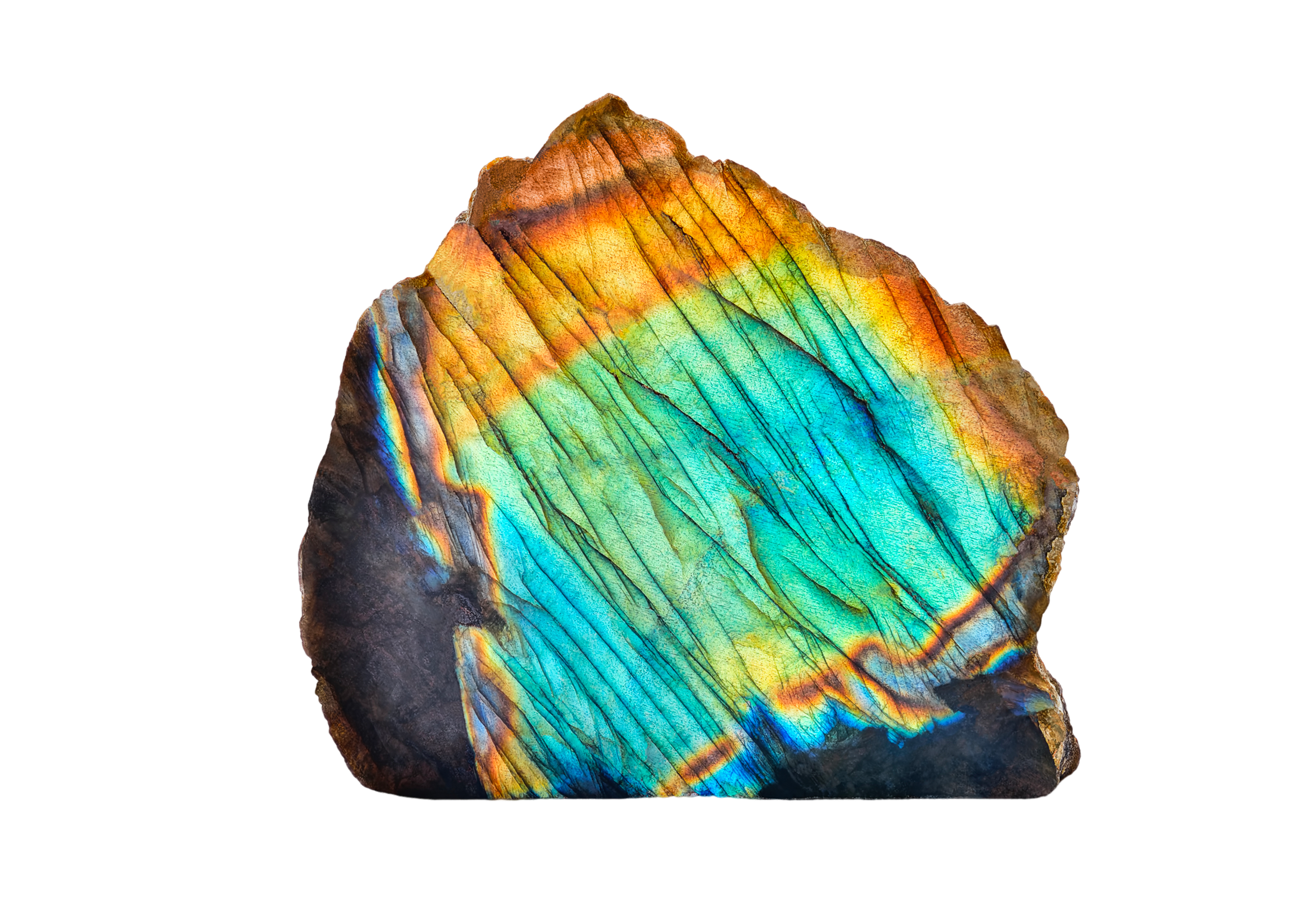
Labradorite, this mineral with impossible reflections. More than a stone, it is a mineral mirage: discovered in the heart of the great Canadian North, venerated by Inuit peoples, and celebrated by 18th-century naturalists. Even today, it fascinates jewelers with its blue-green-gold flashes that seem imprisoned within the rock.
- Nature — plagioclase feldspar, semi-precious stone, hardness 6 to 6.5 out of 10
- Origin — Canada (Labrador), Finland, Madagascar, Russia
- Meaning — protection, intuition, inner transformation
- Chakras — third eye (6th) and throat (5th), according to lithotherapy tradition
- Distinction — labradorescence: play of blue, green, and gold reflections depending on the angle of light
- Sharing Price — from €90 (anklet) to €420 (Tibetan sautoir)
What is labradorite?
Labradorite is a mineral in the plagioclase feldspar family, formed by a succession of thin crystalline layers that refract light in a unique way. This optical phenomenon, called labradorescence, produces iridescent blue, green, gold, or sometimes purple reflections that come to life when the stone is tilted.
Its hardness of 6 to 6.5 on the Mohs scale makes it a solid stone for everyday jewelry, provided it is protected from direct impact. Its base color varies from smoky gray to deep black, sometimes crossed by lighter veins. It is against this dark background that the fires of labradorescence express themselves with the greatest intensity.
Labradorite on the Mohs scale
Origin and geological formation
Labradorite forms in basic magmatic rocks that have cooled slowly, allowing the crystals to develop into regular layers. It is this microscopic layered structure that creates the phenomenon of iridescence so characteristic of the stone. The main deposits are spread across several regions of the world, each offering different fire and intensities.
Main labradorite deposits
Each region leaves its signature on the stone. At Sharing, we work mainly with Malagasy and Finnish labradorite for the intensity of their blue fires.
Mineralogical profile
History and symbolism
Labradorite takes its name from the Labrador Peninsula in northeastern Canada, where it was officially described in 1770 by Moravian missionaries. But long before this Western discovery, the Inuit peoples of the region had known it for millennia. According to their tradition, the Northern Lights were once trapped in the stones of the coast, until a warrior released them with a spear strike — forever leaving a few celestial reflections captive within the rock.
In the 18th century, labradorite became a curiosity prized by European mineralogy cabinets. It inspired the jewelers of the Belle Époque, who appreciated its play of light comparable to that of opal. In the 20th century, the discovery of the Finnish spectrolite deposit, with its particularly intense fires, restored its prestige in contemporary jewelry.
It is this history — between northern legend and jewelry rediscovery — that inspires Sharing's work: a stone that seems to contain a world, set on thread with restraint. Discover our house's history.
The phenomenon of labradorescence
Labradorescence is an optical phenomenon unique to the mineral world. When light enters the stone, it encounters hundreds of crystalline layers stacked on top of each other. These layers, nanometric in thickness, diffract light at different wavelengths — creating the shimmering blue, green, yellow, and sometimes purple reflections we see.
How labradorite's fires are born
It is this same physical principle that gives butterfly wings or peacock feathers their colors: a structural coloration, not a pigmentary one. In other words, labradorite is not blue or green in the chemical sense — it creates these colors from the light it receives. This explains why its luster seems alive, shifting, and never frozen.
This optical singularity makes each labradorite an absolutely unique piece: two stones cut from the same block will never have exactly the same fire.
Properties associated with labradorite
In the lithotherapy tradition, labradorite is considered a stone of protection and intuition. Ancients linked it to the third eye chakra, the seat of intuition according to Indian traditions, as well as the throat chakra, associated with communication.
It is important to note that these correspondences are based on beliefs and traditions, and not on scientifically proven properties. At Sharing, we celebrate above all the mineral beauty of labradorite and the richness of its history.
Traditionally attributed virtues
- Energetic protection; labradorite is said to act as a shield against external negative energies.
- Strengthening intuition; according to some beliefs, it promotes inner clarity and self-listening.
- Support during periods of change; its vibration is traditionally described as a guide through life transitions.
- Emotional soothing; it is said to help channel excessive emotions without suppressing them.
- Stimulation of creativity; according to tradition, it is used by artists and thinkers in search of inspiration.
Lithotherapy is a wellness practice based on ancient traditions, not scientific evidence. The properties mentioned here are based on beliefs and subjective feelings and in no way substitute for medical advice.
The shades of labradorite at Sharing
Not all labradorites are the same, and that is what makes them so rich. At Sharing, we distinguish two major families in our collections, chosen for their distinct character and ability to dialogue with other stones.
Blue Labradorite
Anthracite-gray background crossed with deep blue flashes, sometimes water green. The most versatile shade, the signature of Sharing's Tibetan pieces.
Spectrolite (Finland)
Rare variety with multicolored fires: blue, green, gold, and purple in a single stone. Our exceptional shade, reserved for signature pieces.
Our labradorite creations
Labradorite is one of the most expressive stones for jewelry. Its dark palette crossed with blue fires matches perfectly with tobacco-colored threads, which reveal its dramatic depth, as well as with beige threads, which bring out its iridescence through contrast.
Our labradorite pieces
Tibetan Short Necklace
Blue Labradorite · Tobacco thread
€360
Tibetan Sautoir
Blue Labradorite · Moonstone mix · Beige thread
€420
Tibetan Short Necklace
Labradorite · Black Onyx mix · Tobacco thread
€340
3-loop Loopy Bracelet
Labradorite · Beige thread
€180

Lucy Glasses Chain
Labradorite · Tobacco thread
€150
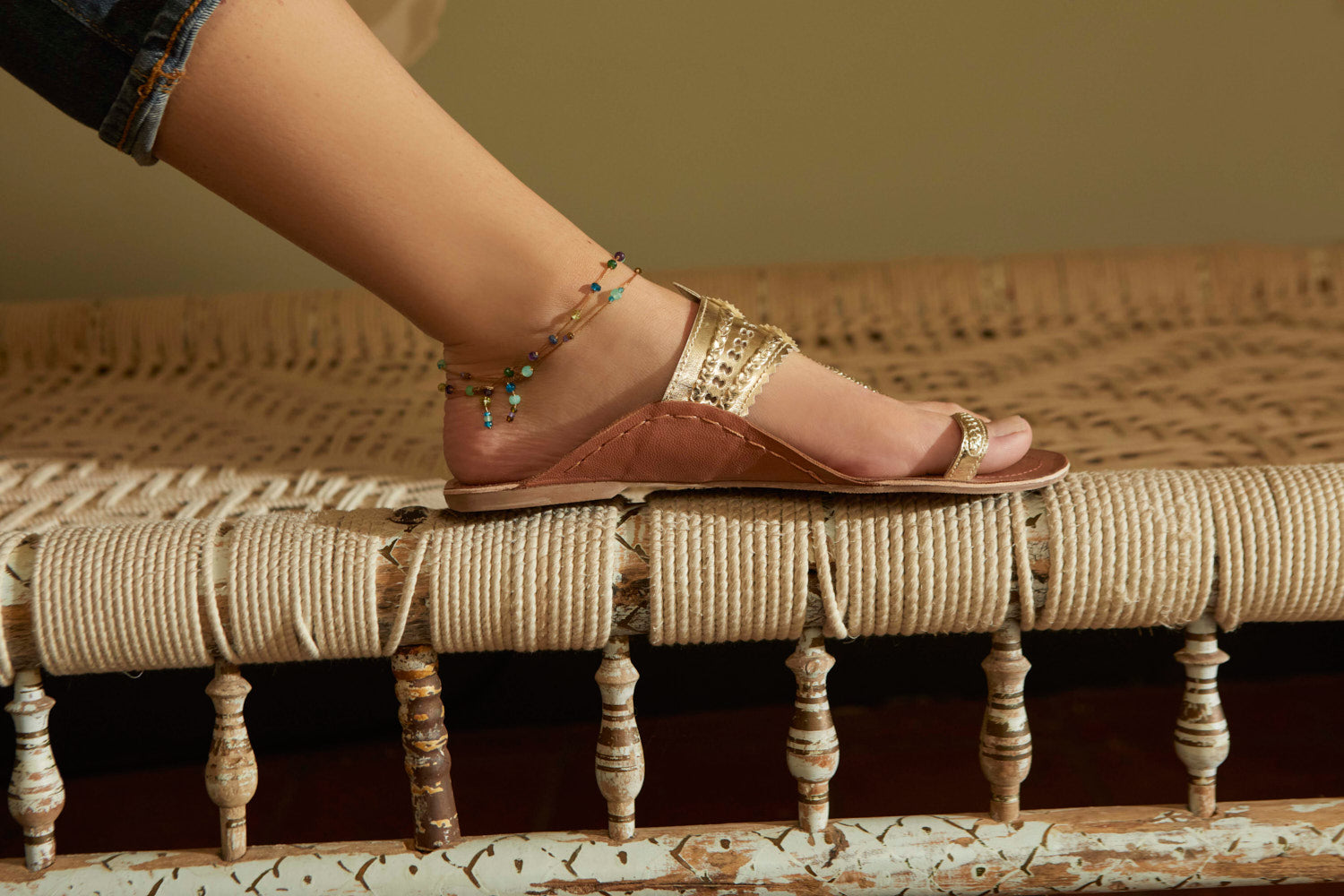
Anky Anklet
Labradorite · Beige thread
€90
Full collection
All our labradorite pieces
Each stone is hand-selected for the intensity of its fires. No two labradorites are identical,
that is the whole Sharing art.
Similar stones and combinations
Several stones share a portion of the chromatic or symbolic universe of labradorite. At Sharing, these combinations add richness to our Tibetan necklaces.
- Moonstone — its cousin from the feldspar family, with softer white and bluish reflections. A natural combination that plays on complementary iridescence.
- Amethyst — its deep purple enters into a dialogue with the blue fires of labradorite in more mystical compositions.
- Aquamarine — to extend the blue shades of labradorescence in a more solar interpretation.
- Lapis lazuli — intense and opaque blue, which highlights the depth of labradorite through contrast.
- Black onyx — for a very contemporary monochromatic interpretation, where only the labradorite's fires provide the color.
How to care for your labradorite?
Labradorite is more delicate than quartz: its lower hardness and layered structure require some precautions to preserve its fire over the long term.
Daily use
- Clean with a soft, slightly damp cloth, never with chemicals or ultrasound.
- Avoid direct impact: the layered structure can crack upon impact.
- For jewelry mounted on thread, avoid prolonged contact with water.
- Remove your jewelry before showering, exercising, or swimming.
Preserving the fire
Unlike amethyst, labradorite does not fear sunlight — its colors being structural and not pigmentary, they do not fade. However, it is sensitive to sudden temperature changes and cosmetic products (perfume, cream, hairspray) which can coat its surface and diminish its reflections. Remember to apply your cosmetics before putting on your jewelry, and store them in the Sharing pouch provided with your purchase.
Rituals of the lithotherapy tradition
According to tradition, some like to "purify" their labradorite with sage smoke (never in salt water, which could alter the stone), and "recharge" it in moonlight. These are symbolic gestures that fall under personal ritual.
Frequently asked questions
Labradorite is a fine stone, also called a semi-precious stone. It has never been classified as a precious stone in the historical sense, but its optical rarity—labradorescence is unique in the mineral world—gives it a special place in contemporary jewelry.
At Sharing, our labradorite creations range from €90 for an Anky anklet to €420 for a Tibetan long necklace with intense flashes. Each stone is hand-selected for the intensity of its labradorescence.
An authentic labradorite has three distinctive signs:
- Labradorescence that varies depending on the angle: the reflections change when you turn the stone
- A grey to black background upon which the flashes appear
- A hardness of 6 to 6.5 on the Mohs scale
Warning: there are imitations made of opalescent glass. All the labradorites used in our Sharing creations are authentic natural stones.
Yes, provided you avoid impacts and contact with cosmetic products. Labradorite has a foliated structure that is more fragile than quartz, but it withstands daily wear very well with careful use.
This phenomenon, called labradorescence, comes from the microscopic lamellar structure of the stone. The crystalline lamellae diffract light at different wavelengths, creating these blue-green-gold reflections. It is a structural coloration, comparable to that of butterfly wings, and not a pigment-based coloration.
Labradorite pairs particularly well with moonstone, amethyst, aquamarine, and black onyx. See our full selection.
Labradorite takes its name from the Labrador Peninsula, in Canada, where it was described in 1770. In Inuit tradition, it is said to contain fragments of the Northern Lights trapped within the rock. In lithotherapy, it is considered the stone of protection and intuition.
Labradorite is traditionally associated with the signs of Scorpio, Sagittarius, Aquarius, and Pisces, due to its connection with intuition and transformation.
Continue exploring
Discover our latest creations
Let yourself be guided by the stone that speaks to you, and find the perfect match among our new arrivals.
See new arrivals